Learning Outcomes:
i. Students will grasp the fundamental principle of floatation, which governs whether an object floats, sinks, or remains suspended in a liquid.
ii. Comprehend the relationship between an object's density and the density of the fluid in which it is submerged, determining whether it will float or sink.
iii. Recognize the role of upthrust, the upward force exerted by a liquid on an object submerged in it, in determining buoyancy.
iv. Apply the concept of floatation to explain the behavior of various objects in different fluids.
v. Appreciate the significance of floatation in various real-world applications, such as shipbuilding, submarine design, and buoyancy-aided devices.
Introduction:
As we observe a ship gracefully gliding across the ocean's surface or a cork effortlessly bobbing in a glass of water, we witness the fascinating phenomenon of floatation. This seemingly simple act, governed by the delicate interplay of forces and densities, has profound implications for our understanding of the physical world. In this lesson, we embark on a journey to unveil the secrets of floatation, exploring the relationship between object density, fluid density, and the forces at play.
i. Density: The Key to Floatation's Enigma
The principle of floatation, a cornerstone of fluid mechanics, revolves around the concept of density. The density of an object is a measure of its mass per unit volume. In the realm of floatation, the density of the object plays a crucial role in determining its fate – whether it will float, sink, or remain suspended.
ii. A Tale of Two Densities: A Balancing Act
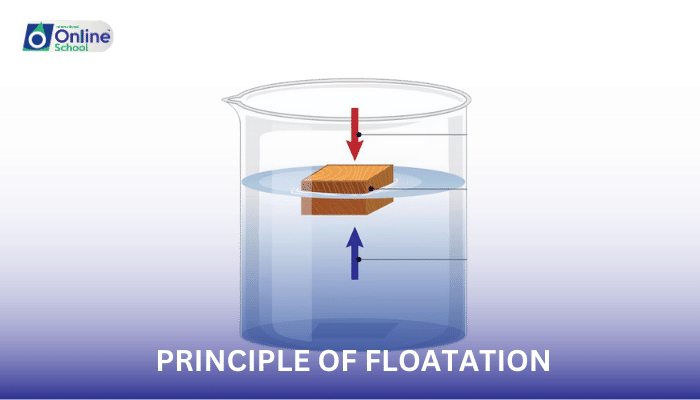
When an object is submerged in a fluid, two opposing forces come into play – the downward force of gravity pulling the object down and the upward force of upthrust pushing it up. Upthrust, exerted by the fluid on the object, is equal to the weight of the fluid displaced by the object.
The behavior of the object – whether it floats, sinks, or remains suspended – depends on the relative values of its density and the density of the fluid. If the object's density is less than the density of the fluid, upthrust will be greater than the weight of the object, and it will float. Conversely, if the object's density is greater than the density of the fluid, upthrust will be less than the weight of the object, and it will sink.
iii. Upthrust: A Force in the Balance
Upthrust, a crucial factor in floatation, is directly proportional to the density of the fluid and the volume of the fluid displaced by the object. This means that objects that displace a larger volume of fluid experience a stronger upward force, and denser fluids exert greater upthrust.
iv. Real-World Applications: Floatation at Work
The principle of floatation has numerous practical applications in various fields:
Shipbuilding: Ship designers carefully consider the density of their vessels relative to the density of water to ensure their buoyancy and stability.
Submarine Design: Submarines utilize controlled adjustments of their buoyancy to maintain their desired underwater depths.
Buoyancy-Aided Devices: Life jackets and flotation devices employ the principle of floatation to keep people afloat in water, providing critical safety measures in emergencies.
The principle of floatation, a fundamental concept in physics, provides a profound understanding of the behavior of objects in fluids. By comprehending the relationship between object density, fluid density, and upthrust, we gain insights into the design of ships, the operation of submarines, and the development of life-saving buoyancy aids. As we observe the diverse applications of floatation, we appreciate its elegance and simplicity, a testament to the interconnectedness of physical principles and the intricate workings of our natural world.
